Belinda Mara Ashton

LIVING IN HARMONY. THIS IS THEIR LAND TOO.
Sharing a few thoughts about my work...
In 20210, when I first launched my Wild Neighbours initiative, I had such hope in my heart that, through my love of nature and my understandings of living alongside wildlife, I could share my knowledge and learnings, and speak out for animals who do not have a voice – an approach inspired by a conversation that I had many years ago with Jane Goodall, which had a lasting impact on me.
I had always hoped to inspire change for the better.
Today, over 16 years later, and having had the very challenging experience of living in an English village where fox hunting is a way of life and then returning to Cape Town for visits, I look around my city and feel heartened to see small stories that speak of progress with regard to an awareness of living with kindness and caring alongside wildlife – especially birds. But I also see how so much has changed for the worse, and most noticeably, how wild tracts of land are no longer wild simply because ever-increasing human needs have meant encroachment into these wild spaces. And with this encroachment comes the myriad impacts of a significant human footprint. I write this with sympathy and respect, knowing that we are all trying to live our lives as optimally as possible.
Change is inevitable; I do understand that, especially in a city. I suppose I had always hoped it would shift in a different direction, where nature was given precedence or at least the space to exist naturally. But I am one voice and, in truth, not a very bold voice. My manner has always been passive rather than proactively fighting the cause, in other words, using the inspiration that flows from my own heart to inform my messaging and knowing that I am often speaking to the ‘converted’ who already have this understanding.
The passage of life shapes who we become, and personal change is inevitable too, especially when one lives with sensitivity and a deep awareness. So, flowing with the change that I observe around me, I have shifted my focus from speaking about wildlife to instead looking at how we can live differently – at home. My philosophy is that through living differently, we can deepen the essence of our own lives and, by extension, how we relate to and impact the world around us.
At its core, I see choosing to honour nature as a way of life.
If we can rewild our own lives, we will over time benefit from all the deep spiritual and physical dimensions that are inherent in our primal connections with nature. And through this more holistic approach, we can lessen our individual footprints, which can have a significant positive impact on the natural environment.
I will be sharing lots more over the course of 2026...

Can you tell us what inspired your interest in urban wildlife?
How did you arrive at the name 'Wild Neighbours' and what support have you had for this initiative?
What motivates you to continue with this project?
Can you leave us with a story of hope?

Living with our Wild Neighbours
This interview was published when my Wild Neighbours booklet was included as an insert in Africa Geographic magazine.

Having grown up in Cape Town and near the beautiful Table Mountain National Park, I always had a profound sense of nature, and my natural empathy and compassion were drawn towards the birds and small creatures that inhabit what is left of the natural environment in the Cape. I could see how the ever-expanding suburbs with their busy roads, increasing light and noise pollution, domestic animals, and myriad human issues were impacting wildlife, and I wanted to become their voice so that people could identify a way to live in harmony with nature and the very attributes that make Cape Town such a unique and species-diverse city.
Urban centres generally develop in natural areas, and the animals that are able to adapt to this encroachment are, in essence, our neighbours. We share the landscape, and occasionally our paths cross, and I have always felt that it is for us to give way so that they can continue their lives as much as possible, unaffected by our presence. That is where the name was derived from, and it resonated with many people, and I now see organisations around the world referring to urban wildlife as 'wild neighbors'.
Until this time, I had published Cape Envirolink, which focused on green issues in Cape Town, and I was also a founding trustee of the Baboon Matters Trust, so I had a very informed understanding of urban wildlife issues.
When I came up with the idea for the programme, I was inspired by a thought- provoking and meaningful conversation that I'd had with Dr Jane Goodall, when she spoke of speaking out for wildlife who do not have a voice.
I then approached Dr John Hadidian, an urban wildlife specialist working for The Humane Society in the US, and his incredible input and interest in my work, as well as financial support, enabled me to launch my programme. I was also supported and encouraged by Dr Andrew Rowan, President of The Humane Society, who was very generous with his knowledge and time.
Wild Neighbours went on to become a Wild Cities Champion, which was lovely recogition.
Since then, I have worked closely with IFAW Southern Africa, and Wild Neighbours awareness signboards have been installed on eco estates and key nature reserves around Cape Town.
I have a deep, almost primal awareness of the land. I can hear birds or pick up tracks in the sand as though by instinct. I have the most profound appreciation for it all. It's inconceivable to me that one day future generations might never know what it feels like to stand outside at night, under the dazzling stars, and hear the foxes 'barking clear and cold' or the sound of baboons barking deep in the mountains. What will life be like without these animals? What could ever fill the emptiness and loneliness of a land void of life?
These are my concerns.
I have lived in rural communities that regularly hunt wildlife. I have seen more roadkill incidents than I care to remember. I have seen the impacts of cats on birds; poison on small creatures; pollution on wild habitats; the decline in insect populations and how this reduced food source impacts bats and migratory birds; and the list goes on and on.
At what point do we ask ourselves: How will we feel one day when the migratory swallows no longer arrive at the onset of summer? What could ever fill their passing? And then, what changes can we make to ensure that they still live among us, nesting in the eaves, catching insects on the wing, and their excited chatter filling the skies as they prepare for their long journey south?
The American writer and anthropologist Margaret Mead once wrote: 'Never doubt that a small group of thoughtful, committed citizens can change the world. Indeed, it is the only thing that ever has.' And across the globe, one reads of rewilding projects; of small community initiatives supporting pollinators; of wolves or indigenous carnivores being reintroduced where they were once hunted to extinction. And these stories provide hope. And what do we have, but the hope that through our collective caring and through the dedication and goodwill of people who are prepared to devote their lives to the cause of a species in plight - the Iain Douglas-Hamilton's of the world - we will turn this tide of impact on wildlife?
Let us hope that one day, when the political landscape has shifted to a more holistic, integrated, and caring approach towards people and the land, we will revert to a reciprocal relationship with the earth, where it supports our lives, and in turn, and with reverence, we protect it for future generations - human and animal - to prosper and enjoy.
You cannot get through a single day without having an impact on the world around you. What you do makes a difference, and you have to decide what kind of difference you want to make.
DR JANE GOODALL
Thank you for the opportunity of receiving your book 'Our Wild Neighbours' - I loved reading it and your words were very touching and conveyed your love of nature and the many creatures that inhabit our world...
JULIA BROWN
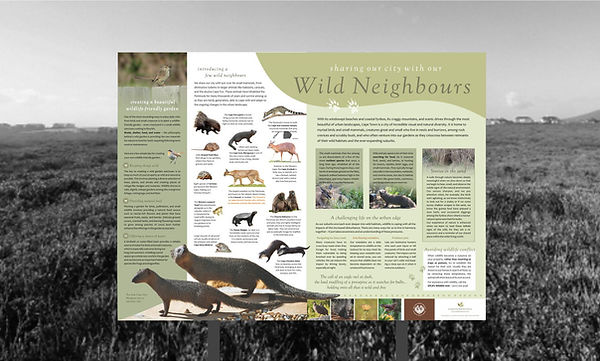
Wild Neighbours interpretative signboards are displayed in all the major nature reserves in Cape Town, as well as on private eco and wine estates.

DOING WHAT WE CAN TO MAKE LIFE EASIER FOR WILDLIFE
It's such a difficult life out there. I think wildlife has always had a challenging time living near people, and it's a story that is thousands of years in the making. The difference today is that we have so much information at our fingertips; we know all the pressures and understand all the complexities and dramas of our ever-expanding human world. We know that behaviours like fox hunting, grouse moor burning, hare coursing, etc., are harmful to wildlife because we can see their impact. Less visible is the insidious effect that these activities have on individual animals. One only has to drive through the countryside to see how wildlife and even certain birds are deeply afraid of us and dash for cover to avoid us. Witnessing this fear is a sad reflection of how we treat them.
Only when we take the time to understand what motivates activities that are unnecessarily harmful to wildlife, can we begin to make the necessary changes to ensure that we live in peace and harmony with the wild lives that all call this patch of land - home.


What would the world be, once bereft Of wet and wildness? Let them be left, O let them be left, wildness and wet; Long live the weeds and the wilderness yet.
GERARD MANLEY HOPKINS

Please be in touch if you would like to chat about hosting my 'Living with our Wild Neighbours' display or need any advice with regard to urban wildlife issues.
